If you run a factory, you've probably wondered whether an AI class will change anything at work. What happens when the staff you send have never even opened ChatGPT?
On September 23 and 24, I taught a two-day class in Hualien for the Stone and Resource Industry Research and Development Center (SRDC). Most participants worked in eastern Taiwan's stone factories. Their days were about cutting, polishing, shipping, and machines. Many were using AI for the first time.
I set one goal: each group would publish a website that could answer customer questions about its factory, using only free tools.
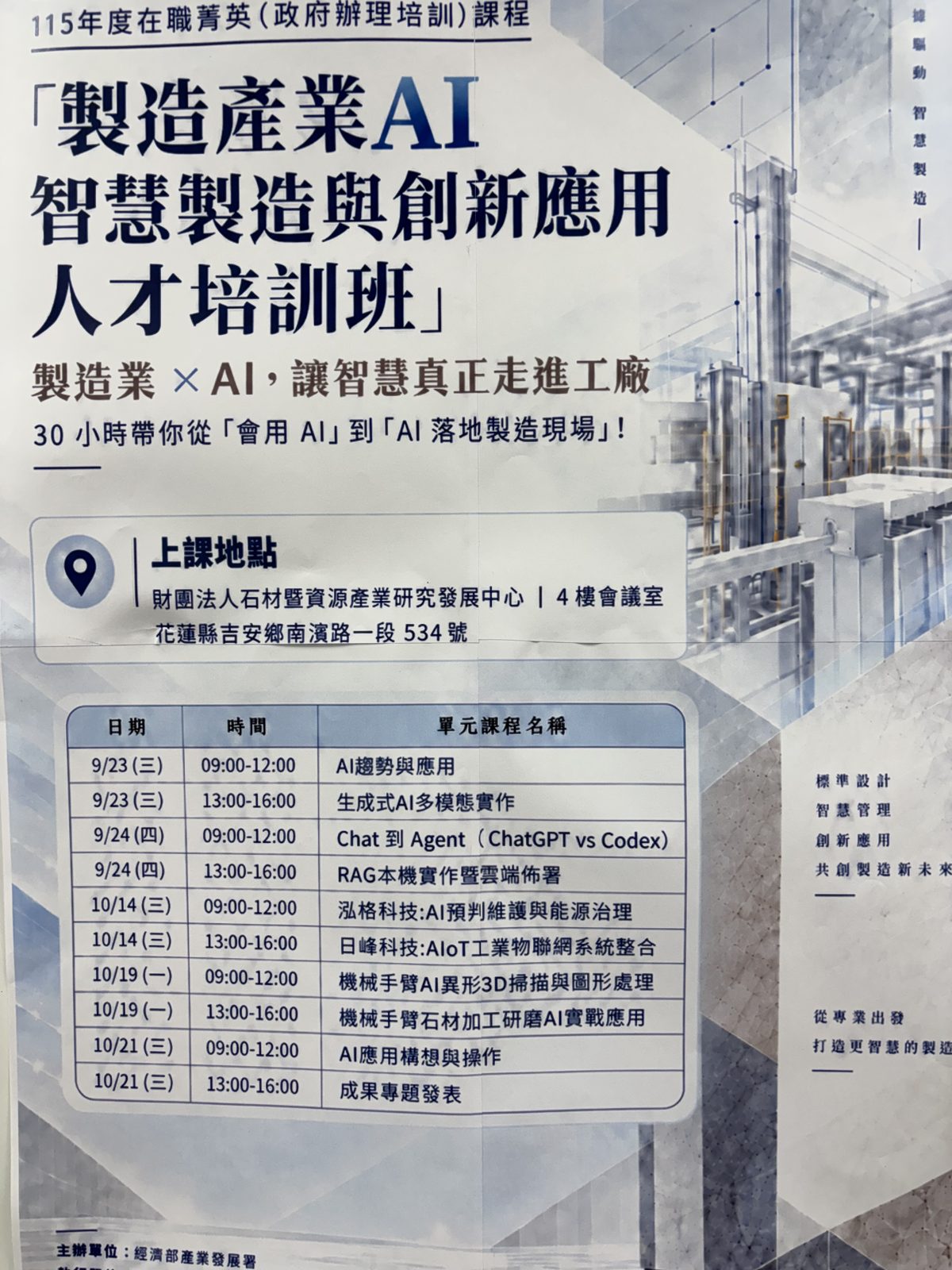
The class was part of a 2026 Ministry of Economic Affairs Industrial Development Administration professional training program on AI in manufacturing. The Taipei Computer Association organized the 30-hour course. I taught the first four units, totaling 12 hours, and was scheduled to return on October 21 for the final project presentations.
Start with tomorrow's work
Many AI classes march through tool demonstrations. People nod, go home, and never open the tools again. The exercises don't connect to what they have to do tomorrow.
Before designing this class, I set three rules:
- Use free tools throughout. Participants should be able to continue at the factory without requesting a budget.
- Finish each unit with something made. Understanding a demonstration isn't the same as producing a file or a site.
- Keep theory to one sentence, then practice.
I didn't open with ChatGPT. I showed three examples from their industry: AI and automation at the 60th Marmomac stone fair in Italy, Cosentino in Spain using AI to review stalled orders, and Swiss building-materials company Holcim automating 90 percent of its 2,000 monthly invoices.
Then I asked: did you notice that none of those examples is about cutting stone? They're about documents and customers. Quotes, orders, and customer questions are already part of factory work. That's where we started.
What participants made in each unit
| Unit | What they left with |
|---|---|
| AI trends and applications | Hands-on practice with five common abilities and six files, including a stone-industry visual, a 3-page product deck, a Word work report, and an Excel order sheet |
| Multimodal generative AI | An AI project loaded with company rules and data |
| From chat to agent | A website other people could open |
| Local RAG and cloud deployment | A live URL that answered from the group's own data |
The turn came on day two: yesterday's tool could talk; today's could do work.
On day one, a participant asked, copied, and pasted. On day two, they gave Codex a task. It opened a folder, changed files, and put a site online. Each group could say, "Make it our factory's site and deploy it." Codex then asked for the factory name, products, and contact details before publishing.
Three things I wanted factory owners to hear
An AI that says "I don't have that information" is safer to put in front of customers.
Each group organized its own FAQ in Excel and connected it to the site's question box. The AI answered from that sheet. If the answer wasn't there, it said sales staff needed to confirm it. A customer assistant that invents answers can do more harm than no assistant.
Customer information belongs on the website; internal records stay inside.
Orders, costs, and maintenance records should not be public. I showed AI reading an ERP-exported order sheet on a local computer, without uploading the records or opening a firewall.
For another demonstration, I used sample factory data: 15 machines and 46 maintenance records. I asked AI to show the factory's equipment. It read the records and produced a monitoring view showing stopped machines and overdue maintenance. Sample data, real workflow. Participants could repeat it with their own data back at work.
Customers are changing how they find suppliers.
They used to search Google for "Hualien stone factory" and scan the first results. Now some ask AI directly which Hualien supplier has black-gold stone in stock and how long delivery takes. A site and FAQ give those tools something about a factory to read.
I showed a system I'd built, not a slide
During class I opened SRDC's own stone AI platform and asked how deep to drill for a wall's dry-hanging installation. When the manual contained an answer, the system used it. When it didn't, the system said so.
I'd previously built that platform for SRDC. It contained data for 82 stone types and 466 material-property tests. The participants saw a working system, then followed a smaller version of the path I had already taken.
I'm Young, founder of Redutek Technology. I work on AI adoption and training for traditional industries. If your factory or industry association wants people new to AI to leave a two-day class with something they can use, let's talk.